
As discussed in Progress Over Credit, good insights challenge the status quo, which can cause clients to resist adoption. However, negative feedback can trigger even greater levels of resistance, as many clients only want positive results.
About 10 years ago, I moderated focus groups with the intention of assessing interest, drivers, and barriers to a certain hardware upgrade subscription concept. Despite the good intentions of creating a program that would mitigate choice paralysis, improve the user experience, and ease budget strain, the concept was almost uniformly rejected for several core reasons:
- Does not solve a problem
- Too expensive over the long run
- General subscription aversion
- Inappropriate upgrade time frame
As instructed, the respondents provided honest and forthright comments, and they very clearly communicated their distain for the concept. From my perspective, this provided pure gold in terms of learning how to improve the concept. When I eagerly entered the back room to gather any last questions, I found my clients angrily shaking their heads and staring daggers through the one-way mirror in what looked like an effort to telepathically let the respondents know the simplicity of their dried-up tiny little consumer brains. Then they turned their scornful eyes to mine, where they successfully communicated their belief in the absolute waste of time and money of the focus groups.

In that moment, I realized that they were too close to the idea, that it was too wrapped into their identity, and too wrapped into their dreams of success. In short, they took immediate and visceral offense to a room full of strangers telling them that their collective baby was ugly.
I knew what they were thinking because I had been in this same situation many times before, except in those scenarios I was the one delivering the bad news. Here, the negative “don’t shoot the messenger” work was done, and I saw the opportunity to step in, not as the messenger, but as the savior.
With a focus on why the respondents felt as they did, I built empathy and therefore understanding of their responses. Then, by reminding my clients of the acceptable alternatives that the respondents suggested, I built a vision of opportunity. Finally, through reframing the responses as requests for improvements towards this opportunity, I opened the door for ideation and exploration.
In short, I turned all of the negative feedback into positive opportunities, which completely disarmed my clients and refocused them on how to improve the concept. This process allowed the clients to solve problems as opposed to defending attacks. Better still, the process of solving those problems lead to their own understanding of the challenges of the concept, which made those issues their own idea, and not just the incoherent ramblings of unsophisticated consumers.
Process for Delivering Negative Feedback
- Set context in terms of clients’ interests
- Build empathy for the customer’s reaction
- Establish success from the customer POV
- Reframe feedback as opportunity
This process served me very well that day and lead to several more engagements with that client before the subscription was successfully launched. Now, when I hear feedback, I work to hear the opportunity as opposed to the issue. I have become so good at this over they years, that I now refer to this process as providing Absolute Value, where the only feedback is positive feedback.
Much like the entertainment industry where almost all stumbles, mistakes, failures, and infractions are given a positive spin, negative research often needs to be cloaked in optimistic and positive packaging in order to be palatable and drive action.
I once provided my research services to a husband and wife team who created a comic strip called Box Office. This strip brought to life the insanity of the inner workings of a publicity and a research department in the entertainment industry. This vignette perfectly brings this sheen machine to life.
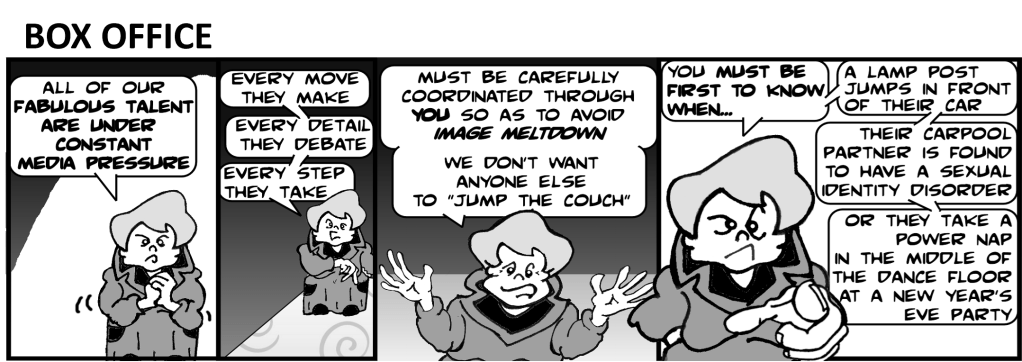
The references here may be a little dated, but the insight still holds true. Take ownership of an issue in a positive context in order to reduce the defensive reflex and to focus people on the joy of coming up with solutions.
If you train your thinking to focus on finding the the positive next step in the feedback, then you will also unlock much deeper levels of questioning in your interviews. Recall how deep you have been able to dig with same context follow ups questions like “why is that”, or “what do you mean by that”. Now imagine what would happen in those situation if you also offered “how would you improve that”, “what has done that better” etc.
Tyrion Lannister in Game of Thrones once said it most starkly (pun intended)…

Once you focus your mind on thinking in the positive and finding the solution, then your follow up questions will allow the respondents to take you there, which in turn, will most likely provide you and your clients with the Absolute Value to take you to greater success.

 RESEARCHADOR
Leave a comment