
Recently, I found myself without a job. Not since I graduated from college have I experienced the uniquely unsettling waves of conflicting emotions that accompany involuntary unemployment. It does not really matter that my layoff was part of a RIF (Reduction in Force), had nothing to do with me or my performance, and was not personal in any way – the mental swirl of “what ifs”, “why me”, and “what now” still assault me and jaggedly coexist in the conflicting and guilt infused feelings of “this is great”, “it’s nice not to work”, and “this is really an opportunity”.
Four months have gone by, and I have about two months left before real panic sets in. In the four months, I have sent out 114 thoughtful, well written, applications to new opportunities. I have tracked down, hit up, and spammed every connection of a connection that I know at these companies with the overt request that they point me in the right direction of the hiring manager, and with the secret desire that they help advocate on my behalf.
At the time of this writing, I have heard back on thirty four submissions (coincidentally 34%), meaning that 66% of these submissions have gone into the void, lost in the Easy Apply swamp of job spammer thoughtless and ill-fit buzz words.
Much like the nonsensical job matches that Glassdoor serves me, these spammers operate under the direction of a poorly crafted mental algorithm that indicates absolutely zero human machine-learning, as they effortless equate Customer Service with Customer Insights, or Data Entry with Data Science. In fact, several studies over the past year have focused on how men are more likely than women to apply for stretch jobs. This difference comes alive in the 2022 report, Gender Differences In Response to Requirements in Job Adverts, where a survey of 10,000 respondents reveals that men apply for a job when they reach about 52% of the qualifications, whereas women apply if they meet 55.7%.
However, the more important take-away here is that almost half of all applicants do not meet the criteria. What this analysis lacks of course, is an understanding of the criticality of the underqualified requirements. If for example, a woman applies for an Accounting position because she lives in the area and is willing to travel even though she no accounting experience, can we conclude she meets two of the three qualifications (66% qualified). As the saying goes, it is the quality, not the quantity, of the qualifications that matter. So, imagine all of those Easy Apply job spammers stuffing incoherent applications into the overflowing pile of trash. These are not “stretch applicants”, but rather “stench applicants” that, as Doug Coughlin says in the 1988 hit Cocktail, “stink up the joint” and mask the beautiful aroma of my otherwise enticing application.

So, how do we clear the air?
Many posts on linkedin that share advice on how to navigate this challenging job market suggest focus and networking. After having gone through the ATS resume optimization exercises, I would conclude that this advice provides the only true path forward, as the ATS optimizers offer the most simplistic understanding of the application of one’s skills to the described job description.
In a job market that mentions the desire for AI experience in every posting, how can the ATS services be so unintelligent as to not understand the equality between “Consumer Research Methods” and “Qual and Quant Research Experience”. When I run my resume and a related job description through these services I tend to score around 10% match. I fail in the most rudimentary comparisons:
- I said “Leader” they wanted “Leadership”
- I said “Mentor” they wanted “Coach”
- I said “A|B testing” they wanted “A/B testing”
And the list goes on and on and on…
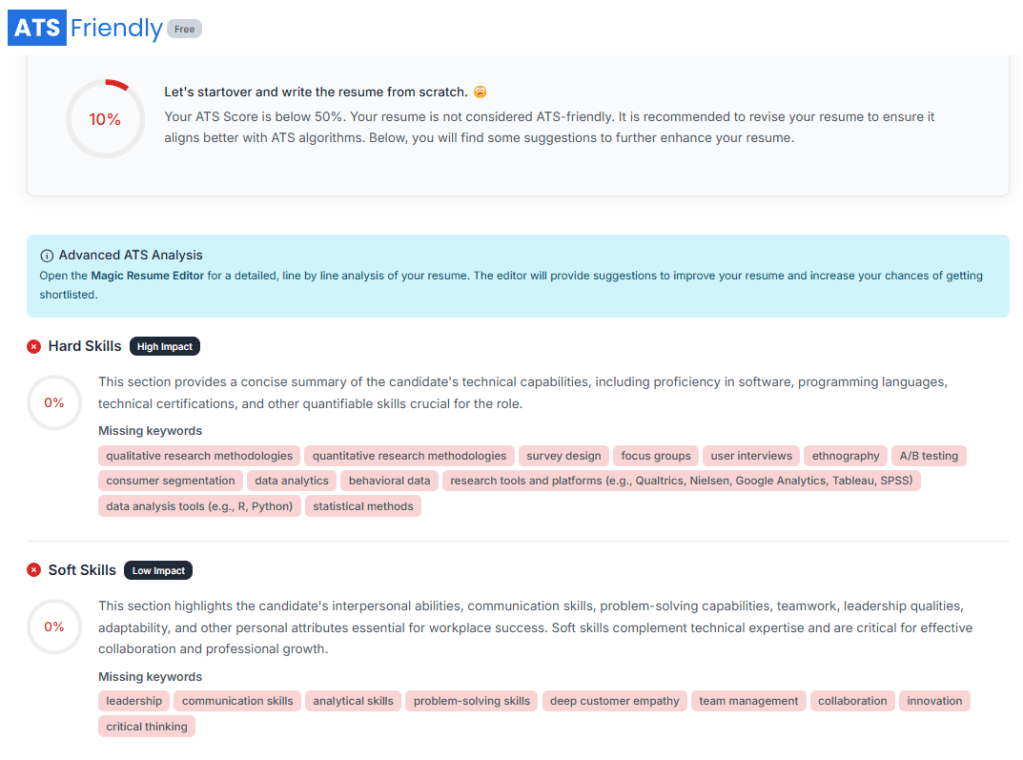
It’s maddening. It’s like that old Fred Armisen and Maya Rudolph sketch from SNL where everyone keeps saying the same word, but they hear it completely differently.

Or for more recent audiences, Brooklyn Nine-Nine’s Boyle vs Peralta battle over the seemingly same pronunciation of Nikolaj.

If this is the level of pre-screening going on at these companies, then it is no wonder why I get “no thank you” emails for jobs that are literally exactly what I have spent my career doing.
It appears that successful applicants must feed the exact job description back to the job posting. In fact, I am going to do an experiment of just that. I will select 10 jobs, tailor my resume as a direct reflection of the job posting, and compare those results against my human tailored applications. More to come on that in time.
In the meantime, the only way to truly clean up the stinky stockpile of stench applicants involves the hard work of a bygone era – direct human interaction. Not only must the applicants reconnect, bow and scrape, and leverage their networks, but so too should the hiring managers and recruiters. The onus should not fall solely on the applicant.
Hiring mangers have it in their best interest to expeditiously fill the role with the best resource. As such, they should not passively wait for the bots to deliver matched resumes that then require additional review and thought to decipher the reality of experience from the rhetoric. Once the code is hacked, any advantage offered by corporate AI resume review, will vaporize, leaving behind only an even larger stinky stockpile of generic resumes.
Regarding focus, I agree that we need to reach beyond our current experiences, but how do we do that in a way that doesn’t let the Dunning-Kruger effect overly empower us to reach well beyond our true capabilities and create even greater inefficiencies in the job search/hiring process.
As applicants, we want to set ourselves up for the greatest probability of success while taking growth-oriented risk. Many self-help coaches want to motivate you to stretch beyond your capabilities. This inspiration tells a simple yet compelling story and paints alluring pictures of wild success to akin to any “snake-oil” sales pitch of then or now.
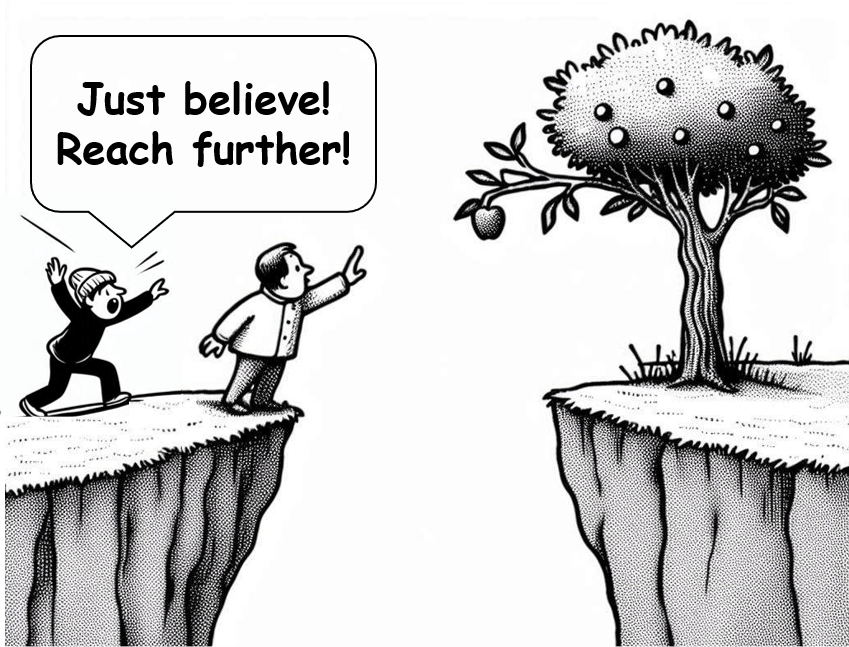
However, suggesting that people do not reach far enough because they do not believe in their capabilities, may over simplify the retrospection of how they got to where they are and why they are not somewhere “better”.
The well known idiom “the grass is always greener on the other side” implies that from one’s current perspective, the situation could be better elsewhere. However, that logic implies that one has forgotten why one made the choices that lead to this perspective. Assuming one makes the best decision given the information at hand, then one is always moving towards the greener grass. Only when one dismisses that Hindsight is 50/50 does one feel the melancholy of “missed” opportunities.
We may observe less than expected stretching, not due to a lack of belief, but rather due to a good understanding of capabilities and timelines as factors towards maximizing the probability of success. Or course, the truth, most likely, lies somewhere in between and each person will fall differently on the spectrum.
So, yes, as employees and applicants, we have to reach, but we have to do so opportunistically and with a realistic assessment of our success-maximizing capabilities, timelines, and risk tolerance. While no growth can occur without discomfort, we want to ensure the greatest probability of successfully grasping that for which we reach. Without a well-founded assessment of one’s capabilities, one may easily overstep the line from a successful Stretch to a deathly Stench.

 RESEARCHADOR
Leave a comment